Showing posts with label female navy pilot. Show all posts

Thursday, February 26, 2015

Women Who Inspire: Interview with Cathy (Donohue) Phillips


Cathy (Donohue) Phillips graduated with a Bachelor of Science in Political Science from the US Naval Academy.  After completing flight training, she was designated a Naval Flight Officer, and reported to Fleet Air Reconnaissance Squadron TWO (VQ-2) in Rota, Spain, where she earned her qualification as an EP-3 Electronic Warfare Mission Commander. Subsequently, she became the first woman to command an EP-3 squadron—Fleet Air Reconnaissance Squadron ONE (VQ-1). During her twenty-five year career, Cathy also served in the Office of Legislative Affairs in Washington, D. C., while concurrently serving as a White House Military Social Aide. She completed US Naval Test Pilot School in Patuxent River, MD, and upon graduation, served as a project officer at Naval Force Aircraft Test Squadron. She has logged over 3,000 flight hours in 23 types of aircraft. In addition, she served at the US Naval Academy, the Office of the Secretary of Defense, and the Defense Information Systems Agency. Cathy retired from naval service in November 2014 with the rank of Captain (O-6).  

AW: Cathy, your resume is sort of out of control. When you graduated from the Naval Academy, did you have any idea that you would be taking this path?

CP: No. None at all. It happened tour by tour. After each tour, I’d say, okay, I’m done. Then they’d offer me the job for the next tour, and I’d think, well, that sounds interesting.

AW: You served as a Naval Flight Officer (NFO) in an EP-3 squadron, VQ-2, in Rota, Spain, as your first tour of duty after flight school. Were there many women in your command?

CP: We had around five hundred people in our command—these are large squadrons—and probably seventy to eighty officers in the wardroom. Of those, maybe four or five were women. Reconnaissance had recently opened up to women when we were in flight school—a stair step leading to women flying  combat aircraft.

AW: And how about on the aircraft itself, when you’d go on missions? What was the crew composition there?

CP: We had twenty-four people on the plane.  We’d carry three pilots, three NFOs, and 18 technical crewmembers. We needed so many people because of the signals intelligence work we did.

AW: Describe this just a bit. What kind of missions did you do and how long were they?

CP: We did a wide variety of missions. We flew a lot in support of Bosnia and Herzegovina doing combat reconnaissance missions. My longest flight was 11.6 hours. We did a lot of looking at battle space, gathered information, we’d talk with entities on the ground, on ships, and on other aircraft, providing real-time situational awareness. We’d never fly above 26,000 feet. I called us big, fat, slow, and ugly!

AW: Ha! And were you flying from Rota or were you forward deployed?

CP: We forward deployed to Souda Bay in Crete. I probably spent almost two years in Crete.

AW: Two years in Greece . . . Are you kidding?

CP: That was a great tour.

AW: No doubt! So on your flights, were you ever the only woman onboard?

CP: Oh, many times.

AW: Any difficulties in this regard?

CP: No. I didn’t really have any issues on my JO [Junior Officer] tour. The only small thing was that we’d always send someone out to the carrier to act as a liaison with the EP-3. I was in the rotation to go to the carrier, but they said they wouldn’t take me aboard, because it was too hard for them to figure out the berthing. [At this time, before 1994, women were prohibited from serving aboard combatant ships]. But that was really it. What I found out later in my career is that there were a few guys who didn’t have trouble working with women, but had trouble working for women, but overall, no big issues.

AW: Which you would know about, since, for example, you were the first woman to command an EP-3 squadron. Which is really amazing when you think about it. When you first started flight school, they had just opened reconnaissance up to women and then—what, seventeen years, eighteen years?—later, you’re taking command of a reconnaissance squadron!

CP: Yeah, everything really opened up for us. Sara [Joyner] was the first female CO [commanding officer] for Hornets. Heidi Fleming took command of a squadron . . .
    
AW: What about ’89, indeed! Now, because you had the unique opportunity to command a squadron, I’m curious how you perceived your female junior officers when you were a CO. Do you see a difference in the female junior officer now as opposed to twenty-five years ago?

CP: I think everything has changed a great deal. The women who were my junior officers when I was a CO were just toddlers when we attended the Naval Academy.

AW: Yikes! How’s that for feeling old?

CP: I know! [laughs]. As you know, our “generation” of officers moved into the fleet just a few years before combatants were opened up to women. It seems, as a whole, we waited later to marry and have kids, if we married or had kids at all. My son was only two years old when I entered my XO [executive officer] and CO tour. What I see now is that the female junior officers are marrying and having children sooner. They’re just having to finesse things differently than we did.

AW: Because you mention your son, I’d like to backtrack to find out about your husband. Where did you meet him and was he in the service, too?

CP: We met in Pax River [Patuxent River, Maryland]. He was a P-3 pilot.

AW: When did you get married and how did that work in terms of co-location?

CP: We dated—long distance—for the first year of my department head tour in Rota, Spain, and then were engaged for the second year. We got married just a few months before I rotated out. I then received orders to the Naval Academy and my husband retired from the service during that tour. This worked out perfectly, because when I eventually took orders to VQ-1 for my XO and CO tour, [Whidbey Island, Washington], he was able to move with me and our son out there and work as a contractor for Homeland Security.
    
AW: How was your command tour?

CP: A hard tour. A good tour. So much to juggle. We had around 500 people operating all over the world. We didn’t deploy as a squadron, but would send detachments out. So we’d send the JOs out with their plane for two months and we had planes all over the world.  We supported Operation IRAQI FREEDOM. We had crews in South America. We had them in Japan for Operation ENDURING FREEDOM. Over the course of that year, when I was CO, I took eight or nine trips around the world to spend time with each detachment. Lots of travel. Lots of time away. Our son was between two and four years old at the time, so that was hard.  But my husband spent a lot of time at home with him and developed a great and very sweet relationship with him. At the end of my CO tour, we were exhausted.

AW: I realize I’m skipping around here, but I want to go back to the tour prior to Test Pilot School, where you were performing two jobs concurrently. You worked in the Office of Legislative Affairs in Washington, D. C. , working as a liaison officer between the House of Representatives and the navy. And at the same time you served as a White House Military Social Aide. I’m curious about the White House job. What was that?

CP: This was a collateral duty that you had to apply and be selected for. There were five or six of us—junior officers from all branches of service—and basically, you were there to help the President and his family host state dinners and receptions.

AW: How cool is that? So what did this entail?

CP: We would have different assignments depending on the dinner. Like one of us might be at the door to greet guests and welcome them to the White House. Or one of us might escort guests upstairs. We met all sorts of people, movie stars, really interesting people.

AW: And were you dressed up? In uniform?

CP: We wore mess dress [a formal uniform in the navy]. And we would also do receiving line duty. And this was actually a highly orchestrated event.

AW: You mean, directing people to the receiving line?

CP: No, more than that. We had several people assigned to the receiving line, all with specific jobs. We had the Announcer, the Pre-Announcer,  the Whisperer—

AW: The Whisperer?

CP: The person who stood behind the President and whispered in his ear about who was coming next in the receiving line. The Whisperer received his information from the Announcers.

AW: Were you ever the Whisperer?

CP: I never got to be the Whisperer.

AW: Anything else we need to know about the inner workings of the receiving line?

CP: We had Pull-off people, too.

AW: Pull-off people? I hesitate to ask. . . .

CP:  Yeah. Pull-off One and Pull-off Two. To keep the receiving line moving, we would have people assigned to “pull” the person talking to the President or another dignitary in order to keep the line moving. “Now, right this way, sir.” Stuff like that.

AW: I had no idea.

CP: You just can’t believe how smoothly everything is run. There’s a civilian protocol officer that orchestrates everything. And I mean everything.

AW: So you enjoyed this job?

CP: Yes, it was a lot of fun. I got to see how the White House runs. But I have to say, no matter who I vote for, I have a ton of respect for whoever sits in the President’s chair and also the President’s family. I mean, I only saw the social part, and that was just crazy.

AW: And then, from White House Military Social Aide to U. S. Naval Test Pilot School. What a crazy swing! Did you have to apply for that and how did it work once you were in?

CP: Yes, you had to apply and there was a selection board. Once you were in, you took one of three tracks: jet, helo, or systems. I took the systems track and when I finished [after graduation from Test Pilot School one year later], I did two years of testing on EP-3 systems.

AW: Your resume says you flew twenty-three different types of aircraft. Did you do all this in Test Pilot School?

CP: Yes. They want you to have an “air sense” about as many aircraft as possible to help round your perspective. I got to fly a wide variety of aircraft like the F-14, F-15, the Beaver—a tail dragger prop—and I got to fly in Italy with the Tornado at the end for my DT2—it’s similar to a final thesis.
   
AW: Your thesis?

CP: Yes, at Test Pilot School it was like getting an aero engineering masters and you have this project at the end that encompasses everything you learned that year.

AW: That is just so flippin’ impressive. With all of these tours—and we didn’t even get to each one of them—did you have a favorite?

CP: I loved each one in different ways . . . which is why I kept staying in. 


Thursday, October 2, 2014

Phrog on Fire: A SEAL's Tale


The helicopter featured in my debut novel, HOVER, is the H-46 Sea Knight, known colloquially as the "Phrog." It was my primary aircraft during my time in the navy and a real treat to fly. John Czajkowski, my Naval Academy classmate and former Navy SEAL, writes this guest post about one of his more memorable flights in the H-46. Thank you, John!


I have a funny story about helo pilots for you starring Denise Shorey [our Naval Academy classmate] and yours truly. She and a senior female pilot were to fly my squad out about 20 NM past Point Loma and drop us and a CRRC [Combat Rubber Raiding Craft] boat out using the "limp duck" drop just after sunset on a beautiful, clear fall evening in the early 90s. Well, this was the first time we had ever flown with female pilots, so some of the guys were a little anxious about it.

So, as luck would have it, as we got about half of the way to the DZ [Drop Zone], sparks and smoke started billowing out of the APU [Auxiliary Power Unit] area. As the bird did a very hard 180 back to NAS [Naval Air Station], I said to Denise over the net that it did appear they would not be dropping us off, and she replied that we might be very useful. She wasn't kidding as the thing was totally on fire now. They dropped down to a very low altitude in case we had to ditch.

I had been in one autorotation/crash with army MH-60s a year prior and would also survive a midair rotor hit while flying with TF160 several years later. Helos . . .WTF is up with them?

Anyway, my squad and I were pleased to look into the cockpit and see the girls flipping a hundred switches/minute and scrambling to try to keep us aloft. Suffice to say, it was exciting to watch the crash trucks following us as we came screaming over NAS NI [Naval Air Station North Island - San Diego] runway. So, there was a box of good tequila delivered to the squadron the next morning.

Thursday, August 14, 2014

A Deployment for Two


Sweet homecoming
I had written three novels of epic fantasy and one medical thriller when I made the decision—finally—to try to get published. For my fifth novel, I knew I wanted to write a love story with a strong female protagonist, but when I began my research into agents and editors, they all called for the same thing—something unique!

At the time, using the Navy as a setting wasn’t an option, a thought, or even a microscopic notion. I had simply never considered it.

I was at such a loss for an idea, I began writing my fourth novel of epic fantasy to fill the time. About six chapters into this new manuscript, now July 2011, the Navy announced it would begin assigning women to submarines. I’ll never forget when my husband looked at me and said, “A woman in the Navy. That’s your story.”

Common advice given to authors is to write what you know. The Navy? I knew this. A love story set in a battle group, particularly with a woman as the main protagonist? Unique. And as a bonus, I knew what it would be like for my protagonist to deploy with someone she loved.

My husband and I met at the Naval Academy and had been married for four years when we deployed together with the USS Nimitz battle group—he on the USS Lake Champlain, a guided missile cruiser, and me on the USS Kansas City, a replenishment oiler. Our first Western Pacific deployment was short by today’s standards, just six months. At that time, in 1993, women were still prohibited from serving on combatant ships, however, a growing number of auxiliary ships were opening their decks to women, including the Kansas City.

My roommate and I were the first women to deploy aboard the Kansas City, members of the air detachment, flying the H-46 helicopter. It was just the two of us, serving with a crew of about 500. Our battle group, now called a carrier strike group, counted four women total—two of our squadron mates were deployed aboard the ammunition ship, USS Shasta—in a task force numbering about 7,000.

Of those 7,000, one was my husband, Bill, who flew the H-60 helicopter. That we were assigned to the same battle group was pure happenstance, a matter of timing more than anything. Because we entered flight school at the same time and eventually received our wings on the same day, the timing of our arrival to our fleet squadrons matched, and our deployment schedules somehow aligned from there—for the first long deployment, anyway.


Bill on the flight deck of the Lake Champlain

Because HOVER takes place in present day, the main characters, Sara and Eric, are able to use email and cell phones to communicate. However, when Bill and I deployed, there was no such thing, not onboard ships, anyway. So we found other ways to communicate. Fortunately for us, the other ships in the battle group relied on the Kansas City for their food, fuel, supply parts and ammunition. We conducted something called CONREP, or connected replenishment, where ships would come alongside ours, lines would be cast between the two to connect them, and hoses run across those lines so we could deliver fuel. During these evolutions, if we weren’t flying, we could wave to each other, while standing on our respective flight decks.

When appropriate, we also talked to each other via the hand-held radios we carried with us for flying, the PRC-90. And when I landed on the Lake Champlain, as we did on daily logistics flights, we took advantage of our in-house “mail delivery system,” otherwise known as passing notes.


Sara and Eric’s story is not the tale of Anne and Bill. Our love story was quite different and maybe there’s another blog article in that. But I drew from our joint experiences in the fabrication of Sara and Eric’s journey, and I’ll briefly touch on one of those angles here—a couple serving in a risky work environment, both in harm’s way. A modern issue, to be sure, now that so many married couples and partners deploy together. 

For example, during work-ups for our deployment, one of our H-46 aircraft had to ditch in the Pacific. Bill was in the cockpit of his H-60, turning on the deck of the Lake Champlain, when the call came that a Sideflare—the call sign for our H-46 helicopter—had gone in the water. Only two Sideflare helicopters were flying that day, so there was a fifty percent chance it was my aircraft. He was about to lift from the deck to provide search and rescue support, when his officer in charge pulled him from the cockpit and replaced him with another pilot. 

Bill remembers that perhaps he may have had a few choice words for his boss for pulling him from a mission. His officer in charge explained that no one knew yet if I was in the helicopter that had gone down. But in Bill’s mind, whether I had been in the bird or not, he felt he should have been able to fly. He clearly remembers the rush of adrenaline and thinking, “A helicopter’s in the water! Let’s go!”

He learned later that I was flying in the second helicopter when the first ditched. In fact, we performed the rescue for the pilot, while the ship sent a small boat to retrieve the remainder of the crew.

The tables were turned during a transit through the Strait of Hormuz, when another helicopter went down, this time at night. Initial reports indicated it was an H-60. As I learned later, Bill did the search for that aircraft, an H-2, which in this case, ended tragically with the deaths of all four crew members.

Comparing notes after each incident, we both admitted reacting in a detached way to those initial reports of helicopters in the water, compartmentalizing and responding to the task at hand of searching for a downed aircraft. The emotional side—What if he/she is in the aircraft?—never kicked in for us.

I want to point out that Sara and Eric react and respond differently than Bill and I would have in several scenes in HOVER, due to the requirements of the story, its arc and plot. But like I said earlier, Sara and Eric are fictional characters in a fictional setting doing things that will hopefully keep the reader turning the pages.

But back to reality, I’ve heard it many times in discussions about integrating women into combat units that men might act differently with women present and vice versa. But what I personally experienced and what we witnessed time and again was consummate professionalism, men and women doing their jobs side by side, just as they were trained. 

Granted, the emotional stakes were higher since we were married. But Bill says that if he ever found himself worrying about me, he would tell himself, “Anne knows what she’s doing. You just need to make sure you know what you’re doing.” I felt the same way, channeling my focus into doing my job well, knowing Bill was doing his, and understanding that worrying wouldn't accomplish much of anything. 

Yes, it was a unique shared experience for a married couple, but the Navy trained us well, and I think we handled it like any professional military service member would, just as our soldiers, sailors and airmen do today.


Tuesday, June 3, 2014

Women Who Inspire: Interview with Catherine (McCann) Gillies

This is the second in a series of interviews of women who inspire the strong female protagonists I favor when writing my novels.

Cathy was notably the first female pilot to fly in any Marine Corps aviation squadron.


Catherine (McCann) Gillies graduated with a Bachelor of Science in Mathematics from the US Naval Academy and reported to flight school in Pensacola, FL. During her 20-year active duty career, she flew the H-3 and H-1 helicopters and was notably the first female pilot to fly in any Marine Corps aviation squadron. She holds two masters degrees and earned a Doctorate in Industrial and Organizational Psychology. She completed her career serving as the Executive Officer of Navy Operational Support Center (NOSC) Baltimore. Catherine retired with the rank of Lieutenant Commander (O-4) and is currently teaching in the Masters of Industrial/Organizational Psychology program for Argosy University Online. Catherine lives with her two daughters and one son in Annapolis, MD.

AW: You flew the H-3 helicopter off of five different aircraft carriers during your time at HC-16. How long were you aboard the carriers typically and what was your primary mission?

CG: We stayed aboard anywhere from a couple of weeks to a couple of months and provided SAR (Search and Rescue) support for jet pilots earning their carrier landing quals. We also helped with hurricane evacuations among other things.

AW: You and your roommate, a USNA ’88 grad, were the first two female pilots stationed aboard the aircraft carrier USS Kitty Hawk. Any sea stories you’d like to relate from that time?

CG: Well, they used to post Marine Corps guards outside our stateroom doors. This was the case on several of the aircraft carriers in the early days. It made my roommate and me uncomfortable because they could hear us moving around the room and talking, so we would order them to leave. Usually, their superiors would send them back, but after several days of back and forth and me reminding them that I outranked their boss, they would finally relent and leave us alone.

AW: You are featured in Linda Maloney’s book, Military Fly Moms. In it, you relate a story that happened on a different aircraft carrier when you called the ship’s weather forecasters for a weather briefing for your flight.

CG: (Laughs). Yeah, I called for a weather briefing, the sailor on the other end of the line laughed, asked me
how I had gotten his number and who had put me up to this. He then stated there were no women aboard the ship before hanging up on me! This was long before the days of cell phones, so I had to be on the ship to call him in his office!

AW: Any other funny carrier moments?

CG: I guess this wasn’t exactly funny for him, but a junior petty officer rounded a corner in the passageway near my stateroom on the Kitty Hawk and obviously wasn’t expecting to see a woman standing there. He just stared—gawking—and while his head was turned, ran straight into the bulkhead.

AW: I guess you were definitely a novelty! Which leads me to your time with HMT-303. You were the first female pilot to be stationed with a Marine Corps squadron, flying Hueys out of Camp Pendleton. I was lucky to have you as an instructor when I transitioned to H-1’s, but how were you received there?

CG: You know, I think you were the only other female I saw come through HMT-303 while I was there. But I would say it was more awkward than my time in Navy squadrons. I was just trying to fit in, but it seemed I was always getting a lot of attention with the base newspaper or the base TV station. It made me stand out when I just wanted to be one of the guys.

AW: Speaking of Marine Corps aviation, can you relate the story about chopping through the halls as a plebe and what you were not allowed to say? [As a plebe, or freshman, at the Naval Academy, you are not allowed to walk in the dormitory hallways—you have to jog, eyes straight ahead. It’s called chopping. And whenever you turn a corner, like to turn down a hallway from the main corridor, you must yell something motivational like “Go Navy!” or “Beat Army!”]

CG: My second classman stopped me in the hall because I had just yelled “Fly Marine Corps, Sir!” He informed me that I couldn't say that since women weren't allowed to fly in the Marine Corps. Ironic, huh?

AW: Love that story. So had you always wanted to go to the Naval Academy?

CG:  I did. I grew up in Annapolis and I was in middle school when the first women were admitted there. I thought how cool it would be to go to sea and travel the world.

AW: Had you always wanted to be a pilot?

CG: No, actually, I was intending to go Surface Warfare, but my roommates at Navy talked me out of it.

AW: Good decision?

CG: Yeah, I loved it, but I will say that throughout my career, I was usually the only female pilot in my squadron. I had the other female pilot in HC-16, and then you came and went at HMT-303, but most often, I was the only one. But, yeah, it was great.

Thursday, May 1, 2014

Women Who Inspire: Interview with Beth (Wainscott) Cronk


In my novels, I favor—surprise—a strong female protagonist. I don’t have to look far for inspiration.

My Naval Academy classmates serve as great examples. Many “female firsts” have come from our 1989 graduating class. At the time, women were still prohibited from serving aboard combatant ships, flying tactical aircraft, or serving aboard submarines. Even if they weren’t “first,” many of my friends found themselves alone or in the extreme minority as they entered and moved through the fleet depending on their job.


Beth Cronk is one such example. I hope you enjoy her interview here.


Beth (Wainscott) Cronk graduated with a Bachelor of Science in Oceanography from the US Naval Academy and reported to flight school in Pensacola, FL. During her 20-year career (10 years active, 10 years reserve), she piloted several aircraft including the T-2B and TA-4J, earning carrier landing qualifications in both, in addition to flying the C-9 and C-12. After leaving active duty, she also flew the 747-400 for four years. Beth retired with the rank of Commander (O-5). She and her husband (also USNA class of 89) now own and operate Hawaii Dream Vacations. Beth lives with her husband and son in Oahu, Hawaii.

AW: Beth, when did you know you wanted to fly jets?

BC: I was just a little girl, so this was in the 70’s. Of course, women weren't allowed to fly jets then, but my parents never told me that.

AW: I love your parents already! They sound extremely supportive. 

BC: Yeah, they were always supportive of my decision to fly and to go to the Naval Academy. In fact, I received appointments to both the Naval Academy and the Air Force Academy, but chose Navy in the end.

AW: You chose well! You were a Navy brat, right?

BC: Yes, my father retired after 29 years of service as a navy captain and flew A-4’s and A-7’s in Vietnam. He went with me to visit the Navy and Air Force campuses to help me with my decision on where to go for college.

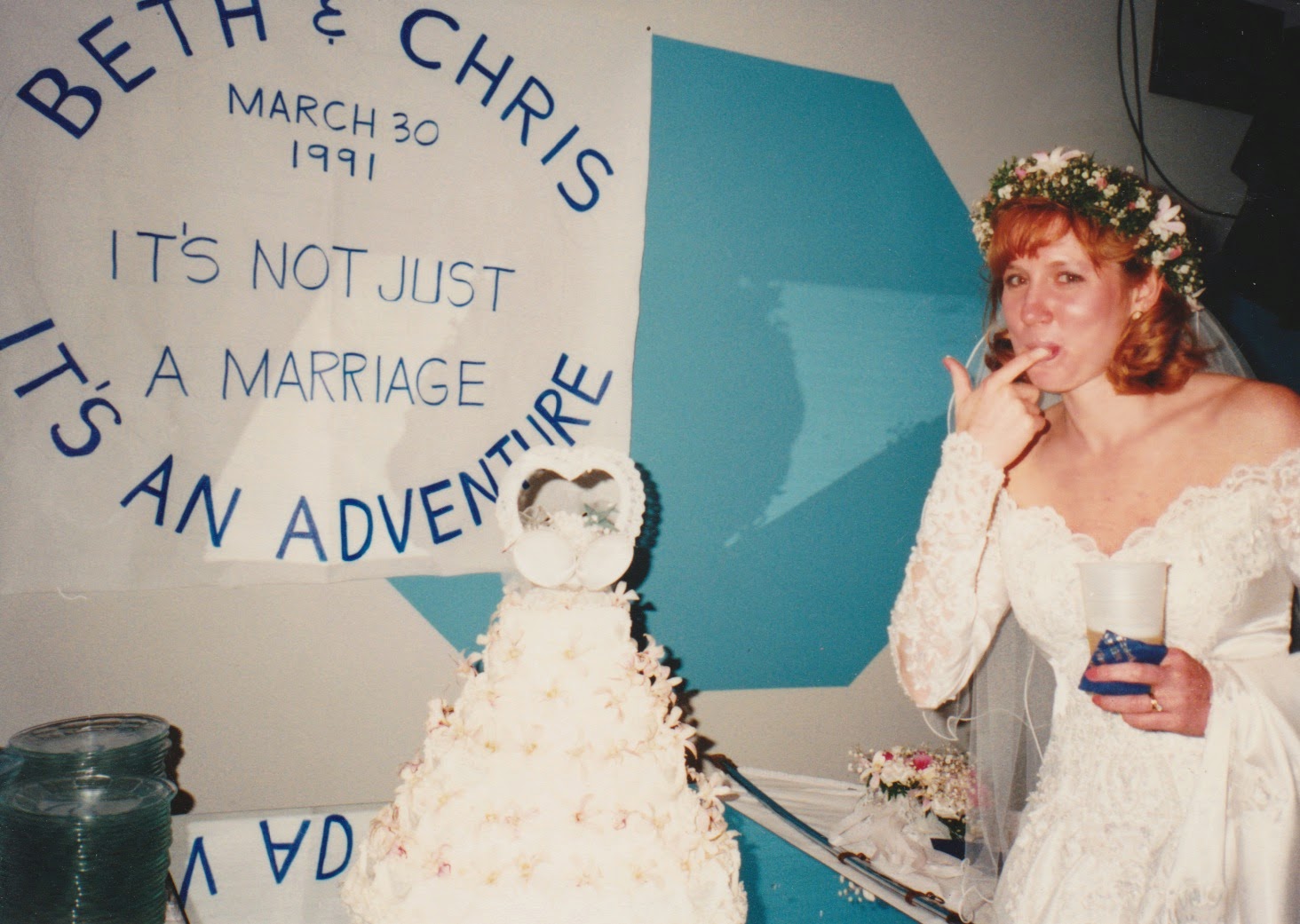
AW: You met your husband, Chris, at Navy. What was the dating scene like?

BC: (Laughs). We met during second class summer and then we were EE [Electrical Engineering] lab partners during the academic year. So our dating consisted of studying together in Chauvenet Hall, basically.

AW: And you got married right after graduation?
Beth Cronk


BC: Actually, we got married two years after graduation, right before I received my wings. I was in Beeville, TX at the time and Chris was an NFO [Naval Flight Officer] in F-14’s stationed in Oceana. So to get co-located, we needed to get married.

AW: When you received your wings, was tactical aviation an option for you at that point?

BC: No. We could remain in the training command as an instructor pilot in the A-4, but that was about it—nothing off the carriers except for C-2’s, but C-2’s were a different training pipeline. It just so happened that at this time, the Navy was going through a huge RIF [Reduction in Force], so my detailer was able to get me into a C-9 squadron [The C-9 is the military version of the McDonnell Douglas DC-9 used for many years by the commercial airlines.] I went on to be an instructor pilot and a post-maintenance check pilot in the C-9.

AW: How many women were in your C-9 squadron?

BC: I think we had four women out of about forty pilots. And then when I flew C-12’s, I think it was two women out of eight pilots.

AW: What about the numbers in flight school in Beeville where you did your jet training?

BC: Oh, in Beeville, it was just Sara [Applegarth Joyner—an 89 classmate] and me in the T-2 squadron, and I think there were only two women in the A-4 squadron—so four of us, total. There were no female instructors at the time and there were only like three or four female staff officers on the base, so maybe eight women total on the entire base!

AW: You relayed a funny story to me via email about the time you did your anthropomorphic measurements when you first entered flight training in Pensacola.

BC: Yeah. Do you remember in primary training when they took every student out to a hangar and had us sit in cockpit mock-ups and take anthropomorphic measurements to see what we could fly? My sitting height is a little short, so they said I could fit in any platform except the A-6. The guy who told me this felt bad that he had to break this news to me—that my options would be limited. I remember laughing and saying something like, "Really? I also have ovaries, which rules out a whole bunch of other aircraft."

AW: That cracks me up! Honestly, you've got so many sea stories, it’s hard to narrow them down and pick which ones to talk about. But I love the tale about you and Kim Nugent, our classmate, on midshipman cruise.

BC: (Laughs again). Kim and I were assigned to a destroyer on First Class Midshipman Cruise. We met the ship when it was anchored off Guantanamo Bay, Cuba. So we take a small boat to go meet the ship and they have cargo netting slung over the side for us to climb to get on board  The only problem was that Kim and I were wearing our summer white skirts and heels! But hey, we had to get aboard. So there we were, climbing the cargo netting in heels with our sea bags slung over our shoulders. Classic!